Trajectory
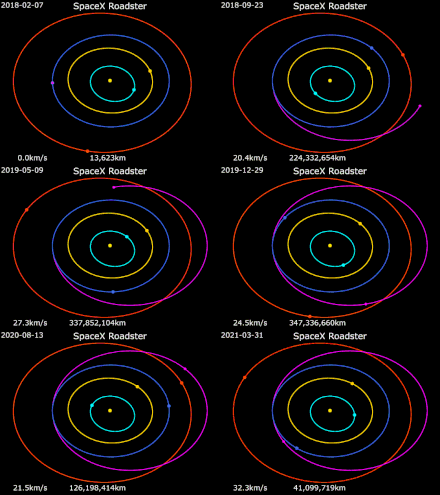
The US Office of Commercial Space Transportation issued the test flight's launch license on February 2, 2018. The rocket lifted off from Launch Complex 39A at Kennedy Space Center at 15:45 EST (20:45 UTC) on February 6. The upper stage supporting the car was initially placed in an Earth parking orbit. It spent six hours coasting through the Van Allen radiation belts, thereby demonstrating a new capability requested by the U.S. Air Force for direct insertion of heavy intelligence satellites into geostationary orbit. Then, the upper stage performed a second boost to reach the desired escape trajectory.
The launch was live streamed, and video feeds from space showed the Roadster at various angles, with Earth in the background, thanks to cameras placed inside and outside the car, on booms attached to the vehicle's custom adaptor atop the upper stage. Musk had estimated the car's battery would last over 12 hours, but the live stream ran for just over four hours, thus ending before the final boost out of Earth orbit. The images were released by SpaceX into the public domain on their Flickr account.
Following the launch, the rocket stage carrying the car was given the Satellite Catalog Number 43205, named "TESLA ROADSTER/FALCON 9H", along with the COSPAR designation 2018-017A. The JPL Horizons system publishes solutions for the trajectory as target body "-143205".
The Roadster is in a heliocentric orbit that crosses the orbit of Mars and reaches a distance of 1.66 au from the Sun. With an inclination of roughly 1 degree to the ecliptic plane, compared to Mars' 1.85° inclination, this trajectory by design cannot intercept Mars, so the car will neither fly by Mars nor enter an orbit around Mars. This was the second object launched by SpaceX to leave Earth orbit, after the DSCOVR mission to the Earth–Sun L1 Lagrangian point. Nine months after launch, the Tesla had travelled beyond the orbit of Mars, reaching aphelion at 12:48 UTC on November 9, 2018, at a distance of 248,892,559 km (1.664 au) from the Sun. The maximum speed of the car relative to the Sun will be 121,005 km/h (75,189 mph) at perihelion.
Even if the rocket had targeted an actual Mars transfer orbit, the car could not have been placed into orbit around Mars, because the upper stage that carries it is not equipped with the necessary propellant, maneuvering, and communications capabilities. This flight simply demonstrated that Falcon Heavy is capable of launching significant payloads towards Mars in potential future missions.

Comments
Post a Comment